Showing posts with label Notes. Show all posts

Prerequisites and Implementation of Performance Budgeting


Performance budgeting stands as a pivotal tool for agencies, organizations, and governments aiming to bolster budget decision-making processes by intertwining financial allocations with program outcomes. To delve into this concept effectively, it's imperative to understand its prerequisites and implementation intricacies:
1. Program-Centric Approach: Performance budgeting necessitates a paradigm shift towards a program-centric approach. Rather than focusing solely on financial inputs, it directs attention towards program outcomes and impacts. By aligning budget allocations with expected program results, organizations can optimize resource utilization and enhance accountability.
2. Utilization of Performance Information: Central to performance budgeting is the utilization of performance information in decision-making processes. This entails presenting budget amounts alongside performance metrics, allowing decision-makers to assess the effectiveness and efficiency of various programs. Such integration empowers stakeholders to make informed funding choices that maximize the attainment of desired outcomes.
3. Establishment of Performance Measurement Systems: Before embarking on performance-based budgeting initiatives, organizations must establish robust performance measurement systems. These systems serve as the backbone for evaluating program effectiveness and efficiency. Through clearly defined metrics and performance indicators, entities can gauge progress, identify areas for improvement, and ultimately optimize resource allocation strategies.
4. Incremental Implementation and Long-Term Vision: Implementing performance-based budgeting is not a one-time endeavor but rather a journey that requires incremental steps and continuous refinement. It's essential to recognize that a fully functional system may not yield desired results immediately. Organizations must exhibit patience and perseverance, understanding that the long-term benefits of enhanced decision-making and resource optimization outweigh initial challenges.
In essence, the successful implementation of performance budgeting hinges on embracing a program-centric mindset, leveraging performance information, establishing robust measurement systems, and adopting a long-term perspective. By adhering to these prerequisites and implementation strategies, organizations can unlock the full potential of performance-based budgeting, driving greater efficiency, accountability, and effectiveness in resource allocation processes.

Understanding Performance Budgeting: Linking Resources to Results

Performance budgeting is a critical aspect of financial management that emphasizes the correlation between resources allocated and the outcomes achieved by an organization, particularly in the public sector. Here, we delve into the intricacies of performance budgeting and its significance in organizational management.

The Essence of Performance Budgeting

Performance budgeting serves as a comprehensive framework that integrates financial allocations with programmatic objectives. Unlike traditional budgeting methods, performance budgeting emphasizes the alignment of financial and physical resources with specific programs, projects, and activities. By doing so, it facilitates a more transparent and accountable allocation of resources, ensuring that funds are utilized efficiently to achieve desired outcomes.

Transparency and Accountability in Resource Allocation

At its core, performance budgeting is a tool for enhancing accountability and transparency in resource allocation. It provides decision-makers with a clear understanding of the costs associated with various programs and activities, enabling them to make informed choices about resource allocation based on their impact and effectiveness. This approach fosters a culture of results-oriented management, where resources are allocated based on the expected outcomes and performance indicators associated with each program or activity.

Prioritizing Spending Based on Goals and Objectives

Moreover, performance budgeting enables organizations to prioritize their spending based on established goals and objectives. By linking financial resources to specific purposes and outcomes, organizations can ensure that resources are directed towards activities that contribute most effectively to their mission and strategic priorities. This targeted approach to resource allocation helps organizations optimize their limited resources and achieve greater efficiency in the delivery of services and programs.

Focus on Outcomes and Performance Measures

One of the key features of performance budgeting is its focus on outcomes and performance measures. Unlike traditional budgeting approaches that primarily consider inputs and expenditures, performance budgeting emphasizes the measurement of outcomes and the evaluation of program effectiveness. By incorporating performance metrics into the budgeting process, organizations can assess the impact of their programs and activities, identify areas for improvement, and make data-driven decisions to enhance performance and accountability.

In summary, performance budgeting represents a fundamental shift in the way organizations approach resource allocation and financial management. By linking resources to results, it enables organizations to achieve greater efficiency, accountability, and effectiveness in the delivery of services and programs. Embracing performance budgeting can empower organizations to make informed decisions, prioritize resources effectively, and ultimately achieve their mission and strategic objectives.

Understanding Performance Budgeting

Performance budgeting represents a paradigm shift in the traditional approach to budgeting, transitioning from a focus solely on inputs to a more comprehensive consideration of outputs and outcomes.

1. Shifts budgeting from decisions on inputs to decisions on outputs or outcomes:

Performance budgeting fundamentally alters the budgeting process by emphasizing the achievement of desired outcomes and the efficient allocation of resources to attain those outcomes. Unlike traditional budgeting, which primarily focuses on allocating funds based on historical expenditures or departmental needs, performance budgeting directs attention towards the results and impacts of spending.

2. No standard definition of performance budgeting:

Performance budgeting lacks a universally accepted definition due to its varied interpretations and implementations across different governmental bodies and organizations. While the core principles of performance budgeting remain consistent, the specific methodologies and practices may differ based on contextual factors such as organizational structure, objectives, and resource constraints.

3. Some governments define performance budgets as budgets that contain information on actual or estimated results:

In certain governmental contexts, performance budgets are defined as financial plans that integrate information on both past and projected outcomes. These budgets provide transparency and accountability by linking resource allocation to the achievement of predefined performance targets and objectives.

4. Budgets in which increments in resources are linked to increments in results:

One of the key features of performance budgeting is the alignment of resource allocations with desired outcomes. Incremental resource increases are justified based on the demonstrated effectiveness and efficiency of previous allocations in producing measurable results. This approach encourages a more strategic and outcome-oriented utilization of financial resources.

5. In the broad definition, performance budgeting is only an analytic tool:

In its broadest sense, performance budgeting serves as an analytical framework for evaluating the efficiency, effectiveness, and economy of government expenditures. It provides decision-makers with valuable insights into the performance of various programs and activities, facilitating informed resource allocation decisions.

6. In the strict definition, performance budgeting serves as a decision rule:

In its strictest interpretation, performance budgeting functions not only as an analytical tool but also as a prescriptive decision-making framework. Under this definition, resource allocation decisions are directly guided by the performance outcomes and objectives outlined in the budget, ensuring that funding priorities are aligned with organizational goals and priorities.

In summary, performance budgeting represents a dynamic approach to budgetary management, emphasizing accountability, transparency, and results-oriented decision-making. While its definitions and applications may vary, the underlying objective remains consistent: to optimize resource allocation and enhance the delivery of public services and outcomes.

Concept of Profit

These are hand written notes by Mrs. Pooja Rakhecha of Youtube Channel Puja Jain Classes, on the topic 'Concept of Profit'. This topic forms a part of syllabus of various universities offering BA Economics, MA Economics, BCom, BBA, MBA, MCom etc.

Mrs. Rakhecha is a Gold Medalist and has exceled in all walks of life, and studies in field of Economics and Laws. She is Professor and Training & Placement Officer at Institute of Management Studies, B. J. S. Rampuria Jain College, Bikaner. She is founder of Puja Jain Classes and Mentor at Aditya Classes.

Students studying BBA, BCom and MCom from Universities like Maharaja Ganga Singh University, Bikaner(MGSU), Mohan Lal Sukhadia University, Udaipur(MLSU), Maharshi Dayanand Sarasvati University, Ajmer(MDSU), Rajasthan University, Jaipur(Rajasthan University or RU), Jai Narayan Vyas University, Jodhpur(JNVU), Banaras Hindu University, Varanasi(BHU), Aligarh Muslim University, Aligarh(AMU), Chhatrapati Shahu Ji Maharaj University, Kanpur(CSJMU), Bundelkhand University, Jhansi(BU), University of Allahabad, Allahabad(Allahabad University), University of Lucknow, Lucknow(Lucknow University), Babasaheb Bhimrao Ambedkar University, Lucknow(BBAU), Deen Dayal Upadhyaya Gorakhpur University, Gorakhpur(DDU), Dr BR Ambedkar University, Agra(DBRAU), Chaudhary Charan Singh University, Meerut(CCSU), Mahatma Jyotiba Phule Rohilkhand University, Bareilly(MJPRU) can use these hand written notes.

Perfect Competition

These are hand written notes by Mrs. Pooja Rakhecha of Youtube Channel Puja Jain Classes, on the topic 'Perfect Competetion'. This topic forms a part of syllabus of various universities offering BA Economics, MA Economics, BCom, BBA, MBA, MCom etc.

Mrs. Rakhecha is a Gold Medalist and has exceled in all walks of life, and studies in field of Economics and Laws. She is Professor and Training & Placement Officer at Institute of Management Studies, B. J. S. Rampuria Jain College, Bikaner. She is founder of Puja Jain Classes and Mentor at Aditya Classes.

Students studying BBA, BCom and MCom from Universities like Maharaja Ganga Singh University, Bikaner(MGSU), Mohan Lal Sukhadia University, Udaipur(MLSU), Maharshi Dayanand Sarasvati University, Ajmer(MDSU), Rajasthan University, Jaipur(Rajasthan University or RU), Jai Narayan Vyas University, Jodhpur(JNVU), Banaras Hindu University, Varanasi(BHU), Aligarh Muslim University, Aligarh(AMU), Chhatrapati Shahu Ji Maharaj University, Kanpur(CSJMU), Bundelkhand University, Jhansi(BU), University of Allahabad, Allahabad(Allahabad University), University of Lucknow, Lucknow(Lucknow University), Babasaheb Bhimrao Ambedkar University, Lucknow(BBAU), Deen Dayal Upadhyaya Gorakhpur University, Gorakhpur(DDU), Dr BR Ambedkar University, Agra(DBRAU), Chaudhary Charan Singh University, Meerut(CCSU), Mahatma Jyotiba Phule Rohilkhand University, Bareilly(MJPRU) can use these hand written notes.

Monopoly

These are hand written notes by Mrs. Pooja Rakhecha of Youtube Channel Puja Jain Classes, on the topic 'Monopoly'. This topic forms a part of syllabus of various universities offering BA Economics, MA Economics, BCom, BBA, MBA, MCom etc.

Mrs. Rakhecha is a Gold Medalist and has exceled in all walks of life, and studies in field of Economics and Laws. She is Professor and Training & Placement Officer at Institute of Management Studies, B. J. S. Rampuria Jain College, Bikaner. She is founder of Puja Jain Classes and Mentor at Aditya Classes.

Students studying BBA, BCom and MCom from Universities like Maharaja Ganga Singh University, Bikaner(MGSU), Mohan Lal Sukhadia University, Udaipur(MLSU), Maharshi Dayanand Sarasvati University, Ajmer(MDSU), Rajasthan University, Jaipur(Rajasthan University or RU), Jai Narayan Vyas University, Jodhpur(JNVU), Banaras Hindu University, Varanasi(BHU), Aligarh Muslim University, Aligarh(AMU), Chhatrapati Shahu Ji Maharaj University, Kanpur(CSJMU), Bundelkhand University, Jhansi(BU), University of Allahabad, Allahabad(Allahabad University), University of Lucknow, Lucknow(Lucknow University), Babasaheb Bhimrao Ambedkar University, Lucknow(BBAU), Deen Dayal Upadhyaya Gorakhpur University, Gorakhpur(DDU), Dr BR Ambedkar University, Agra(DBRAU), Chaudhary Charan Singh University, Meerut(CCSU), Mahatma Jyotiba Phule Rohilkhand University, Bareilly(MJPRU) can use these hand written notes.

Cost Volume Profit - Break-even Analysis

These are some practice questions on the topic 'Cost Volume Profit - Break-even Analysis' from subject like Financial Management, Economics.

Students studying BBA, BCom and MCom from Universities like Maharaja Ganga Singh University, Bikaner(MGSU), Mohan Lal Sukhadia University, Udaipur(MLSU), Maharshi Dayanand Sarasvati University, Ajmer(MDSU), Rajasthan University, Jaipur(Rajasthan University or RU), Jai Narayan Vyas University, Jodhpur(JNVU), Banaras Hindu University, Varanasi(BHU), Aligarh Muslim University, Aligarh(AMU), Chhatrapati Shahu Ji Maharaj University, Kanpur(CSJMU), Bundelkhand University, Jhansi(BU), University of Allahabad, Allahabad(Allahabad University), University of Lucknow, Lucknow(Lucknow University), Babasaheb Bhimrao Ambedkar University, Lucknow(BBAU), Deen Dayal Upadhyaya Gorakhpur University, Gorakhpur(DDU), Dr BR Ambedkar University, Agra(DBRAU), Chaudhary Charan Singh University, Meerut(CCSU), Mahatma Jyotiba Phule Rohilkhand University, Bareilly(MJPRU) can use these questions for practice.

Definitions of Production Management

Production function is that part of an organization, which is concerned with the transformation of a range of inputs into the required outputs (products) having the requisite quality level.

Production is defined as “the step-by-step conversion of one form of material into another form through chemical or mechanical process to create or enhance the utility of the product to the user.” Thus production is a value addition process. At each stage of processing, there will be value addition.

Edwood Buffa defines production as a process by which goods and services are created.

Some examples of production are manufacturing custom-made products like, boilers with a specific capacity, constructing flats, some structural fabrication works for selected customers, etc., and manufacturing standardized products like, car, bus, motorcycle, radio, television, etc.

Introduction to Production Management

Production/operations management is the process, which combines and transforms various resources used in the production/operations subsystem of the organization into value added product/services in a controlled manner as per the policies of the organization. Therefore, it is that part of an organization, which is concerned with the transformation of a range of inputs into the required (products/services) having the requisite quality level.

The set of interrelated management activities, which are involved in manufacturing certain products, is called as production management. If the same concept is extended to services management, then the corresponding set of management activities is called as operations management.


Production and Operation Management

This is Syllabus of Production and Operation Management as prescribed by Maharaja Ganga Singh University, Bikaner.

Students of other Universities can tally the topics and read the notes accordingly or ask us to prepare a page like this for their University and subject. You can contact us here.

You can click on the topic to reach the notes of any of the topics below.

Unit- I

Introduction to Production Management: Introduction; History of Production and Operations Management; Definitions of Production Management; Production Process; Production: The Heart of an Organization; Objectives of Production Management; Scope of Production Management. location and layout. Forecasting: Qualitative and Quantitative Techniques of Forecasting.

Unit- II

Production Planning and Control: Nature of Production Planning and Control (PPC): Types of Plans, Elements of Production Planning, Strategy of Production Planning, Aggregate Planning; Main Functions of Production Planning and Control (PPC): Master Production Schedule (MPS); MRP-I and MRP-II. Line balancing.

Unit- III

Project Analysis: PERT/CPM: Programme Evaluation Research Task (PERT) and Critical Path Method (CPM): Principles of Network Construction, Time Aspect of Projects, Crashing of a Project.

Unit- IV

Classification, role of inventory in supply chain, inventory costs, Economic order quantity (EOQ), Economic batch quantity (EBQ) and Quantity discount model. Lead time, Reorder Point, concept of service level and safety stock, Selective inventory control systems. Importance of Maintenance, Breakdown, Preventive TPM (Total Productive Maintenance)

Unit-V

Work Study: Work Study as a Science, Work Study and Productivity, Outline Process Chart, Importance of Work Study; Method Study: Definition, Objectives and Procedure: Objectives of Method Study, Method Study Procedure, Therbligs; Work Measurement: Objectives of Work Measurement, Techniques of Work Measurement, Time Study, Work Sampling.


Types of Research

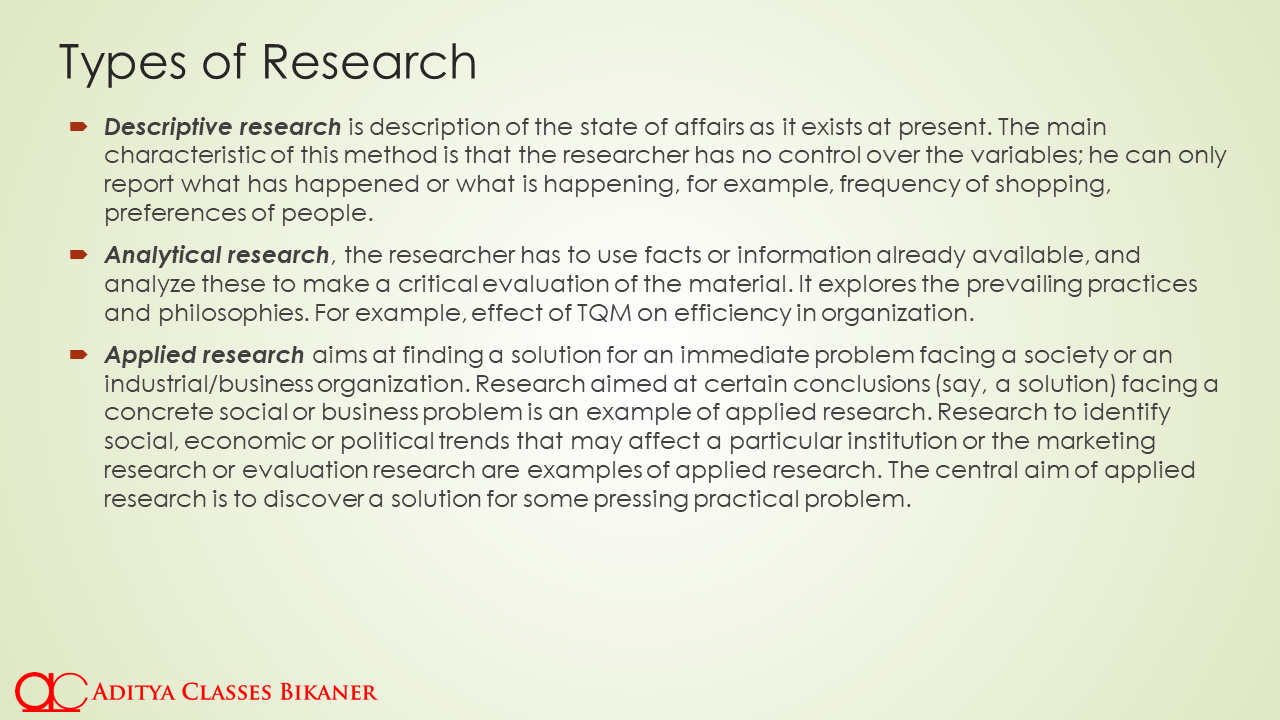
Descriptive research is description of the state of affairs as it exists at present. The main characteristic of this method is that the researcher has no control over the variables; he can only report what has happened or what is happening, for example, frequency of shopping, preferences of people. 

Analytical research, the researcher has to use facts or information already available, and analyze these to make a critical evaluation of the material. It explores the prevailing practices and philosophies. For example, effect of TQM on efficiency in organization.

Applied research aims at finding a solution for an immediate problem facing a society or an industrial/business organization. Research aimed at certain conclusions (say, a solution) facing a concrete social or business problem is an example of applied research. Research to identify social, economic or political trends that may affect a particular institution or the marketing research or evaluation research are examples of applied research. The central aim of applied research is to discover a solution for some pressing practical problem.

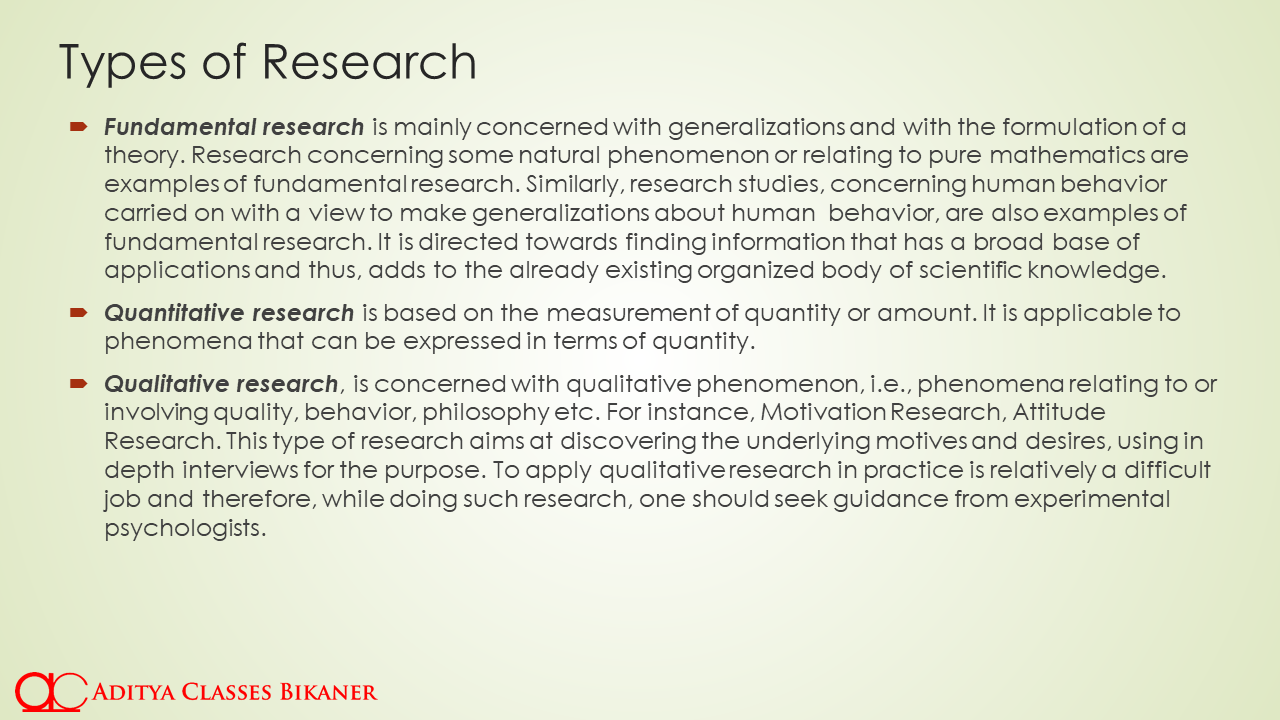
Fundamental research is mainly concerned with generalizations and with the formulation of a theory. Research concerning some natural phenomenon or relating to pure mathematics are examples of fundamental research. Similarly, research studies, concerning human behavior carried on with a view to make generalizations about human  behavior, are also examples of fundamental research. It is directed towards finding information that has a broad base of applications and thus, adds to the already existing organized body of scientific knowledge.

Quantitative research is based on the measurement of quantity or amount. It is applicable to phenomena that can be expressed in terms of quantity.

Qualitative research, is concerned with qualitative phenomenon, i.e., phenomena relating to or involving quality, behavior, philosophy etc. For instance, Motivation Research, Attitude Research. This type of research aims at discovering the underlying motives and desires, using in depth interviews for the purpose. To apply qualitative research in practice is relatively a difficult job and therefore, while doing such research, one should seek guidance from experimental psychologists.

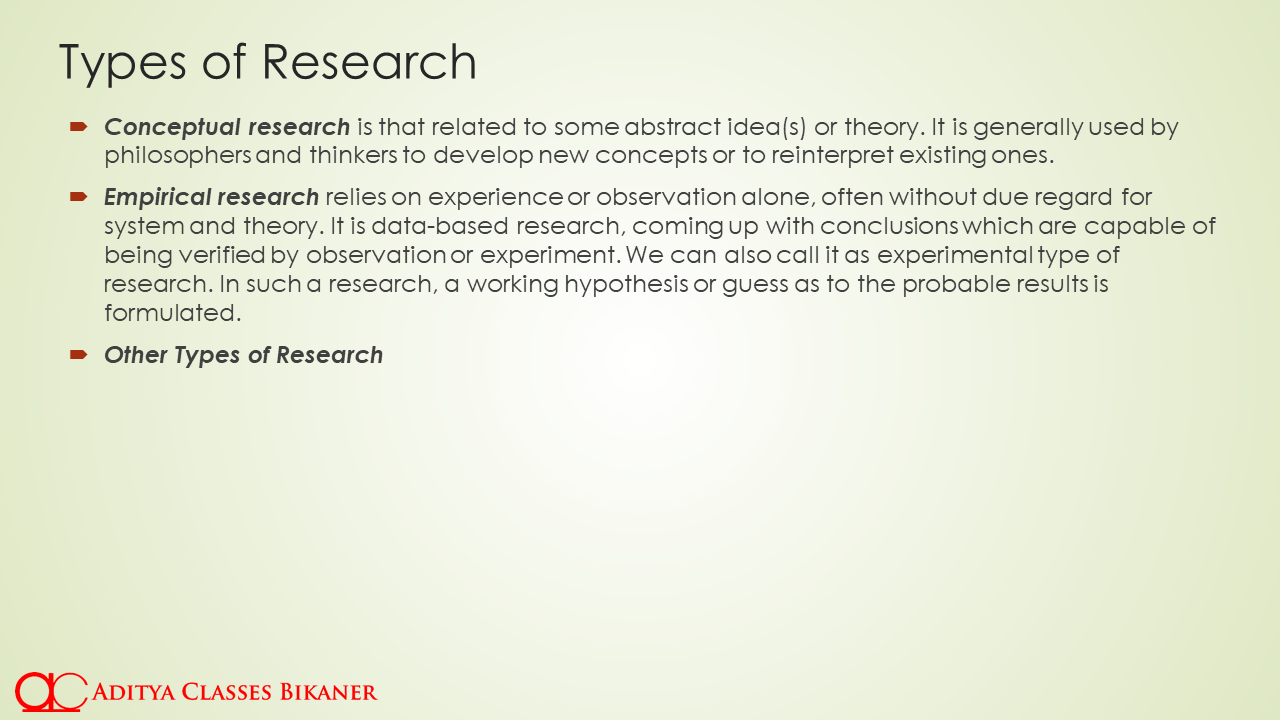
Conceptual research is that related to some abstract idea(s) or theory. It is generally used by philosophers and thinkers to develop new concepts or to reinterpret existing ones. 

Empirical research relies on experience or observation alone, often without due regard for system and theory. It is data-based research, coming up with conclusions which are capable of being verified by observation or experiment. We can also call it as experimental type of research. In such a research, a working hypothesis or guess as to the probable results is formulated.


Limitations of Business Budgeting

  • Based on Estimates
  • Danger of Rigidity
  • Budget execution is not automatic
  • Internal Struggle
  • Encouragement to dictatorial tendency
  • No substitute of management
  • Expensive system
  • Time consuming


Advantages of Budgeting

  • Determination of goals
  • Clear cut delegation of Authority and Responsibility
  • Development of cooperative and coordinating attitude
  • Improvement in communication
  • Performance evaluation and control
  • Optimal utilisation of resources
  • Cost consciousness
  • Increase in employee's morale and productivity
  • Measurement of efficiency
  • Management by Exception
  • Since input is required from multiple units, it promotes coordination, planning, and sharing
  • Allows a firm to anticipate problems so that corrective action can be taken early


The Programs to Fulfil Basic Human Aspirations

Our basic aspirations are happiness and prosperity. To achieve them we continuously involve in various activities and accumulating various things. But unfortunately, we are not able to fulfil our aspirations. The reason is that we don’t know what we really need to fulfil our requirements and their correct priority. 

Basic Requirements for Fulfilling the Aspirations

The basic requirements for fulfilling the aspirations of every human being are:

  • Right Understanding: This refers to higher order human skills – the need to learn and utilize our intelligence most effectively.
  • Good Relationships: This refers to the interpersonal relationships that a person builds in his or her life – at home, at the workplace and in society.
  • Physical Facilities: This includes the physiological needs of individuals and indicates the necessities as well as the comforts of life.

We can say that these requirements are patterned on the lines of the hierarchy of needs. Abraham Maslow has given the concept of the hierarchy of needs. According to him there are five needs which can be placed in a hierarchy depending on which needs a person initially strives to fulfill. The lowest needs are the physiological needs. Once these are fulfilled, they are followed by safety and security needs. These are followed by social needs. The next level of needs relates to the person’s need for self-esteem. The highest order need relates to the need of self-actualization and will only become important if all the other needs are fulfilled.

We can verify this by a set of proposals.

  • “Physical facilities are necessary for human beings.”
  • “Physical facilities are necessary for human beings and they are necessary for animals.”
  • “Physical facilities are necessary and complete for animals, while they are necessary but not complete for humans.”

For Animals: Animals need physical things to survive, mainly to take care of their body.

For Humans: While physical facilities are necessary for human beings, they are not complete by themselves to fulfil our needs. Our needs are more than just physical facilities; Besides physical facilities, we want relationship.

By relationship, we mean the relationship we have with other people, or human beings; father, mother, brother and sisters, our friends, our teachers; we desire good relationships with all of them.

We Want

In Relationship: Mutual Fulfilment: If there is a problem in relationship, we feel uneasy, it bothers us. Even if we are interacting with someone, and something we said or did offends them, it makes us uneasy; i.e. we want mutual fulfilment in relationship.

In Physical Facilities: Prosperity in Us, Enrichment in Nature: Prosperity means the feeling of having or being able to have more physical facilities than is needed. If we don’t have the feeling of prosperity, we will exploit others. Similarly, as we interact with nature for our various physical needs, either exploit nature or enrich it. But our natural acceptance is that we want to live in harmony with nature.

What is Our State Today in Relationship?

We are unable to have fulfilling relationships all the time: in family, outside family, and as a society – in the world at large.

In Physical Facilities

We want to feel prosperous, but end up working only for accumulation of wealth. We want to enrich nature, but are exploiting it, destroying it.

Why we are in This State? – Living with Wrong Assumptions

We seem to be interacting with lots of people, we keep getting ourselves into troubles in our relationships. This issue is basically because we assume something about relationships, and then we go on to live them on the basis of this assumption. But if our assumption is false, then we end up in problems.

Similarly, we have assumed that accumulation of wealth is the only thing we need and the rest shall be taken care of. We have also made numerous assumptions about our interaction with nature, that we can exploit nature, that nature is present solely of our consumption and so on and so forth. These are incorrect assumptions.

What is the Outcome of the Misconception?

  • At the level of individual– Rising problems of depression, anxiety, suicides, stress, insecurity, increasing health problems, lack of confidence and conviction etc. 
  • At the level of family– Breaking up of joint families, mistrust and disharmony in relationships, divorce, generation gap, dowry deaths, neglect of older people etc.
  • At the level of society– Growing incidences of terrorism, violence, communalism, racial and ethnic struggle, corruption, adulteration, sex-crimes exploitation, wars between nations, proliferation of lethal weapons etc.
  • At the level of nature– Global warming, weather imbalances, depletion of mineral and energy resources, deforestation, soil degradation etc.

All the problems are a direct outcome of an incorrect understanding, our wrong notion about happiness and prosperity and their continuity – this is an issue for serious exploration.

What is the Solution? – The Need for Right Understanding

In order to resolve the issues in human relationships, we need to understand them first, and this would come from ‘right understanding of relationship’.

Similarly, in order to be prosperous and to enrich nature, we need to have the ‘right understanding’. The ‘right understanding’ will enable us to work out our requirements for physical facilities and hence correctly distinguish the difference between wealth and prosperity. With nature as well, we need to understand the harmony in nature, and how we can complement this harmony.

Two Categories of Persons

Presently, as we look around, we find most of the people in the following two categories:

  1. Those who do not have physical facilities/ wealth and feel unhappy and deprived.
    SVDD – Sadhan Viheen Dukhi Daridra – Materially deficient Unhappy and deprived.
  2. Those that have physical facilities / wealth and feel unhappy and deprived.
    SSDD – Sadhan Sampann Dukhi Daridra – Materially affluent - Unhappy and still deprived (not so prosperous) While the natural acceptance of all human beings is to be: 
  3. Having physical facilities and feeling happy and prosperous
    SSSS – Sadhan Sampann Sukhi Samriddha – Materially adequate – Happy and prosperous.

Our Program

Understanding and live in harmony at all levels of living

  1. Right understanding
  2. Relationships
  3. Physical facilities

Our state of happiness or unhappiness depends on the above three aspects. If we have right understanding, then we can be happy in ourselves and we do not have the right understanding, then we have problems. Thus, our happiness depends on the fulfilment of these three basic requirements.

Our State Today

There is conflict/contradiction in our thoughts or living at most of these levels of existence, we are unable to naturally accept our own thoughts and living. These problems are basically because of lack of right understanding. We do not even understand ourselves properly. What we need how much of it do we need, what we value – we have not understood this properly.

Human Consciousness and Animal Consciousness

Giving all priorities to physical facilities only or to live solely on the basis of physical facilities, may be termed as ‘Animal consciousness’

  • For animal, physical facility is necessary as well as complete – whereas for human beings it is necessary but not complete.
  • Working only for physical facilities is living with Animal Consciousness.
  • Working for right understanding as the first priority followed by relationship and physical facilities implies living with Human Consciousness.
  • There is a need for transformation from Animal Consciousness to Human Consciousness. It can be accomplished only by working for right understanding as the first priority.
  • This transformation from Animal Consciousness to Human Consciousness forms the basis for human values and values-based living. This is the prime objective of the present course.

Basic Human Aspirations - Continuous Happiness and Prosperity

Every human being is continuously trying to do things to make him/ her happy and every human being is capable of feeling this happiness in himself/ herself spontaneously. In addition to happiness we aspire for adequate fulfilment of our bodily needs. Nobody wants to be deprived even for a single moment.

Happiness

The state or situation in which I live if there is harmony/ synergy in it, then I like to be in that state or situation. i.e. to be in the state of liking is happiness.

Happiness is a state of mind or feeling characterized by contentment, love, satisfaction, pleasure or joy. A variety of biological, psychological, religious, and philosophical approaches have striven to define happiness and identify its sources. Happiness may be described as consisting of positive emotions and positive activities. There may be three kinds of happiness: pleasure, engagement, and meaning. In other words, freedom from want and distress, consciousness of the good order of things, assurance of one’s place in the universe or society, inner peace and so forth. Happiness is the state of mind, where we feel good in most of the walk of life. Philosophers and religious thinkers often define happiness in terms of living a good life; or flourishing, rather than simply as an emotion. 

Prosperity

Prosperity is the feeling of having or making available more than required physical facilities.

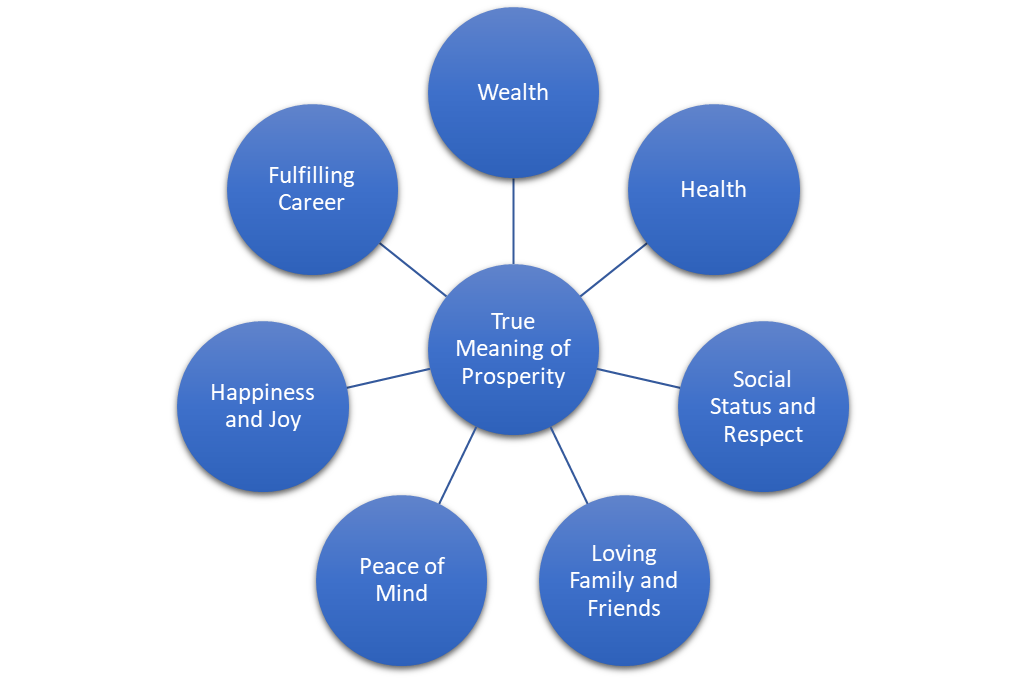
Prosperity is the state of flourishing, thriving, success or good fortune. Prosperity often encompasses wealth but also includes other factors which are independent of wealth to varying degrees, such as wisdom and health. The word means the sum of three aspects – health, wealth and wisdom. Almost all of us feel that wealth alone means prosperity and try to explain this phenomenon on this non-existent or half fact. This is the state of enlightenment towards better life and happy society.


Difference between Prosperity and Wealth

Wealth is a physical thing. It means having money or having a lot of physical facilities or both. Prosperity is a feeling of having more than required physical facilities.

Prevailing Notions of Happiness and Prosperity

We are trying to achieve happiness and prosperity by maximizing accumulation and consumption of physical facilities. It is becoming anti-ecological and anti-people, and threatening the human survival itself. Some of the consequences of such trend are summarized below:

  • At the level of individual – rising problems of depression, psychological disorders, suicides, stress, insecurity, etc.
  • At the level of family – breaking of joint families, mistrust, conflict between older and younger generations, insecurity in relationships, divorce, dowry tortures, etc.
  • At the level of society – growing incidence of terrorism and naxalism, rising communalism, spreading casteism, racial and ethnic struggle, wars between nations, etc.
  • At the level of nature – global warming, water, air, soil, noise etc. pollution, resource depletion of minerals and mineral oils, etc.

Natural Acceptance

Natural acceptance implies unconditional and total acceptance of the self, people and environment. It also refers to the absence of any exception from others. Once we fully and truly commit ourselves on the basis of natural acceptance, we feel a holistic sense of inner harmony, tranquillity and fulfilment. Actually, natural acceptance is way to accept the good things naturally. Learn everything that is good from others, but bring it in, and in our own way absorb it; do not become others. In other words, natural acceptance is process to understand ourselves first. Try to find out he ego stage. Try to reduce that. Open our eyes and look around. The world is full of good things. We need to accept the right naturally. Once it starts coming naturally, we will feel that we are actually upgraded ourselves and now we are above then the rest of the world. Problems are the part of life and natural acceptance is the answer of that.

Characteristics of Natural Acceptance

  • Natural acceptance does not change with time
  • It does not depend on the place
  • It does not depend on our beliefs or past conditionings
  • This natural acceptance is ‘constantly there’, something we can refer to
  • Natural acceptance is the same for all of us: it is part and parcel of every human being, it is part of humanness

Experiential Validation

Experiential validation is a process that infuses direct experience with the learning environment and content. It may be regarded as a philosophy and methodology in which the direct experience and focused reflection of the individual helps to increase knowledge, develop skill and clarify values.

We are often told to accept ourselves for who are. Most of what we know about our self is not only through our own opinion of our self but also because of how others view us. When what we already believe to be true of us is validated by some situations, phenomena or outcomes. We may term it as experiential validation.

What is the State Today?

Today, we are not oriented enough to evaluate our beliefs or assumptions and we treat them as our personal life. We generally keep them secure in the name of personal life and freedom. We usually become very sticky about them without really verifying them. When these come in conflict, we try hard to search out justifications and make all efforts to defend our own assumptions. In the process, we cheat us ourselves as well as others.

It shows that today:
  • Neither are we verifying our assumptions/ proposals put to us on the basis of our natural acceptance
  • Nor we verifying what we think we know, in our living.

What is the Way Out? What Do We Need to Do?

Realization and Understanding:

As we continue with the process of verification of proposals on the basis of our natural acceptance and test it out in our living, it ultimately results in realization and understanding in us. This means knowing something to be true for sure, within ourselves. The answers we get on having realization and understanding are assuring, satisfying and universal. Universal means the answer is same for everyone. They are invariant with respect to time, space and individual. If the answers we get do not fulfil any of the criteria it means the answer is most likely coming from our past beliefs/conditioning and not from our natural acceptance.


Self-exploration

Self-exploration is the process to find out what is valuable to me by investigating within myself, what is right for me, true for me, must be judged within myself. Through self-exploration we get the value of our self. The value of any entity is its participation in the larger order. In the case of human being, to understand what is valuable, we need to study ourselves and the “larger order” around us, which is everything around us.


We live with this entirety (family, friends, air, soil, water, trees, etc.) and we want to understand our relationship with all these. For this I need to start observing inside. What we are doing is we are observing outside, but not inside (“what I feel when I saw this”).

Meaning and Purpose of Self-exploration

  • It is a process of dialogue between “what you are” and “what you really want to be”: It is a process of focusing attention on our self, our present beliefs and aspirations vis-à-vis what we really want to be (that is to say, what is naturally acceptable to us). If these two are the same, then there is no problem. If on investigation we find that these two are not the same, then it means we are living with this contradiction (of not being what we really want to be) and hence, we need to resolve this contradiction this conflict within us. It is a process of discovering that there is something innate, invariant and universal in all human beings. This enables us to look at our confusions and contradictions within and resolve them by becoming aware of our natural acceptance.
  • It is a process of self-evolution through self-investigation: It successively enables us to evolve by bridging the gap between ‘what we are’ and ‘what to be’. Hence, the self-exploration leads to our own improvement, our self-evolution – we will become qualitatively better.
  • It is a process of knowing oneself and through that, knowing the entire existence: The exploration starts by asking simple questions about ourself, which gives our clarity about our being, and then clarity about everything around us.
  • It is a process of recognizing one’s relationship with every unit in existence and fulfilling it: It is a process of becoming aware about our right relationship with other entities in existence and through that discovering the interconnectedness, co-existence and other in the entire existence, and living accordingly.
  • It is a process of knowing human conduct, human character and living accordingly: It is a process of discovering the definitiveness of human conduct and human character and enabling one to be definite in thought, behavior and work.
  • It is a process of being in harmony in oneself and in harmony with entire existence: This process of self-exploration helps us to be in harmony with ourself and with everything around.
  • It is a process of identifying our innateness and moving towards self-organization and self-expression: This process of self-exploration helps us to identify our swatva and through that acquiring swantantrata and swarajya. Swatva: Innateness of self – the natural acceptance of harmony Swatantrata: Being self- organized – being in harmony with oneself Swarajya: Self-expression, self- extension – living in harmony with others Swatva Swatantrata Swarajya The swatva is already there, intact in each one of us. By being in dialogue with it, we attain swantantrata enabling us to work for swarajya.

Content of Self-exploration

  • The Desire/Goal: What is my (human) Desire/ Goal?
  • Program: What is my (human) program for fulfilling the desire?

The main focus of self-exploration is myself- the human being. Basically, it should dwell on the following two key questions:

  • What do I really want in life, or what is the goal of human life?
  • How to fulfill it? What is the program to actualize the above?

In short, the above two questions cover the whole domain of human aspirations and human endeavor. Thus, they form the content of self- exploration.

Process of Self-exploration

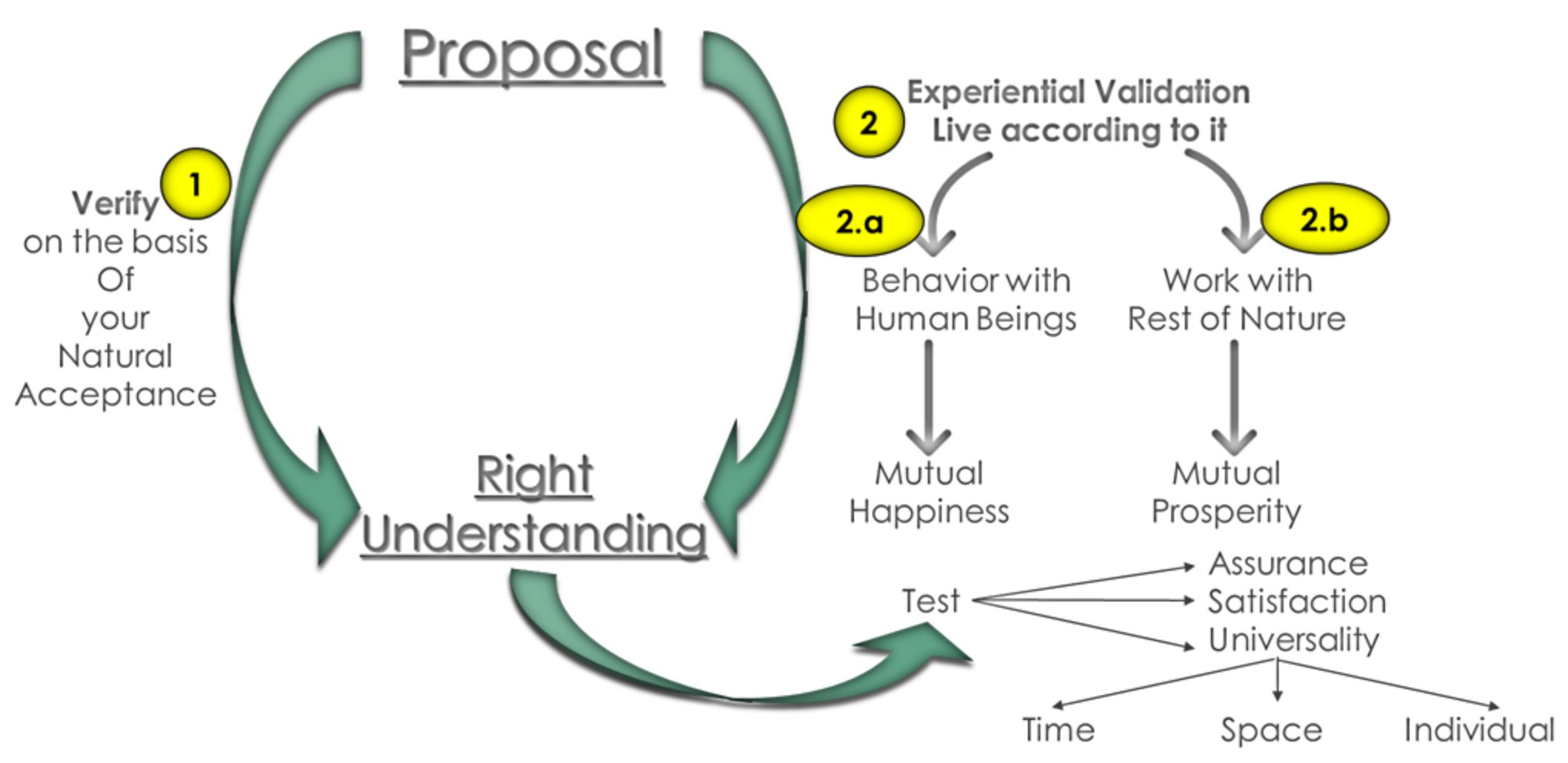
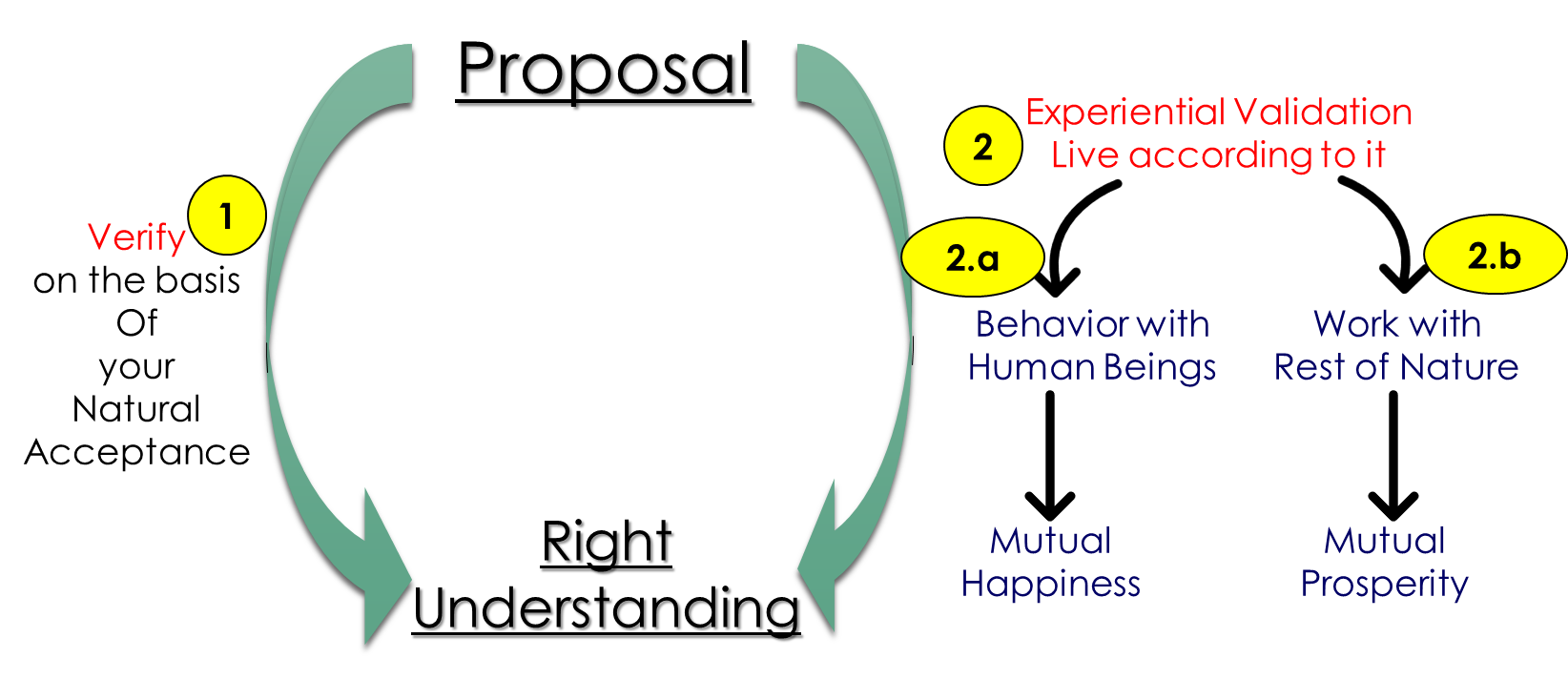
Whatever is being presented is a PROPOSAL.
  • Don’t assume it to be true immediately, nor reject it without proper exploration.
  • Verify it in your own right, on the basis of it being naturally acceptable to you,
    • Not just on the basis of scriptures
    • Not on the basis of equipment/instrument data
    • Not on the basis of the assertion by other human beings.

Therefore, it is essential to carefully ponder over these on your own right. Neither accept these as true immediately nor reject them prematurely without proper exploration.

Don’t just accept / reject these only on the basis of the following:

  • Because something like this/ different from this, has been mentioned in scriptures,
  • Or, because it has been preached/ denied by some great men,
  • Or, a large number of people possess such a view / a different view,
  • Or it is claimed to have been verified through some physical instrument or, claimed that this is beyond the domain of verifiability by physical instruments.
Then what to do
  • Verify on the basis of your natural acceptance
  • Live accordingly to validate it experientially
    • If the proposal is true in behaviour with human leads to mutual happiness
    • If the proposal is true in work with rest of the nature leads to mutual prosperity
  • Results in realization and understanding
  • On having realization and understanding we get
    • Assurance
    • Satisfaction
    • Universality (Applies to all time space and individual)

Remember, it is a process of self- exploration, therefore, it has to be authenticated by us alone by means of verification at the level of natural acceptance and experiential validation. The process is shown in the diagram below Take for example: a proposal- ‘respect’ is a value in human relation. When I verify at the level of natural acceptance, I find that it is naturally acceptable to me. Similarly, when I behave with respect, it is mutually fulfilling to me and to the other.

Thus, the proposal is ‘True’. If it fails on any of the two tests, it is untrue. This verification leads to realization of the truthfulness of the proposal and it becomes part and parcel of my understanding. It is reflected in my thoughts and in my behavior.

Mechanism of Value Education

If one can explore and understand the self in such a manner that he/she grasps the essence of the self there may never need to be any reason for psychological help at a large stage. The two mechanisms for self-exploration may be identified as;
  • Natural Acceptance
  • Experiential Validation.

Theories of Interest

These are hand written notes by Mrs. Pooja Rakhecha of Youtube Channel Puja Jain Classes, on the topic 'Theories of Interest'. This topic forms a part of syllabus of various universities offering BA Economics, MA Economics, BCom, BBA, MBA, MCom etc.

Mrs. Rakhecha is a Gold Medalist and has exceled in all walks of life, and studies in field of Economics and Laws. She is Professor and Training & Placement Officer at Institute of Management Studies, B. J. S. Rampuria Jain College, Bikaner. She is founder of Puja Jain Classes and Mentor at Aditya Classes.

Students studying BBA, BCom and MCom from Universities like Maharaja Ganga Singh University, Bikaner(MGSU), Mohan Lal Sukhadia University, Udaipur(MLSU), Maharshi Dayanand Sarasvati University, Ajmer(MDSU), Rajasthan University, Jaipur(Rajasthan University or RU), Jai Narayan Vyas University, Jodhpur(JNVU), Banaras Hindu University, Varanasi(BHU), Aligarh Muslim University, Aligarh(AMU), Chhatrapati Shahu Ji Maharaj University, Kanpur(CSJMU), Bundelkhand University, Jhansi(BU), University of Allahabad, Allahabad(Allahabad University), University of Lucknow, Lucknow(Lucknow University), Babasaheb Bhimrao Ambedkar University, Lucknow(BBAU), Deen Dayal Upadhyaya Gorakhpur University, Gorakhpur(DDU), Dr BR Ambedkar University, Agra(DBRAU), Chaudhary Charan Singh University, Meerut(CCSU), Mahatma Jyotiba Phule Rohilkhand University, Bareilly(MJPRU) can use these hand written notes.


Theories of Rent

These are hand written notes by Mrs. Pooja Rakhecha of Youtube Channel Puja Jain Classes, on the topic 'Theories of Rent'. This topic forms a part of syllabus of various universities offering BA Economics, MA Economics, BCom, BBA, MBA, MCom etc.

Mrs. Rakhecha is a Gold Medalist and has exceled in all walks of life, and studies in field of Economics and Laws. She is Professor and Training & Placement Officer at Institute of Management Studies, B. J. S. Rampuria Jain College, Bikaner. She is founder of Puja Jain Classes and Mentor at Aditya Classes.

Students studying BBA, BCom and MCom from Universities like Maharaja Ganga Singh University, Bikaner(MGSU), Mohan Lal Sukhadia University, Udaipur(MLSU), Maharshi Dayanand Sarasvati University, Ajmer(MDSU), Rajasthan University, Jaipur(Rajasthan University or RU), Jai Narayan Vyas University, Jodhpur(JNVU), Banaras Hindu University, Varanasi(BHU), Aligarh Muslim University, Aligarh(AMU), Chhatrapati Shahu Ji Maharaj University, Kanpur(CSJMU), Bundelkhand University, Jhansi(BU), University of Allahabad, Allahabad(Allahabad University), University of Lucknow, Lucknow(Lucknow University), Babasaheb Bhimrao Ambedkar University, Lucknow(BBAU), Deen Dayal Upadhyaya Gorakhpur University, Gorakhpur(DDU), Dr BR Ambedkar University, Agra(DBRAU), Chaudhary Charan Singh University, Meerut(CCSU), Mahatma Jyotiba Phule Rohilkhand University, Bareilly(MJPRU) can use these hand written notes.


Theories of Wages

These are hand written notes by Mrs. Pooja Rakhecha of Youtube Channel Puja Jain Classes, on the topic 'Theories of Wages'. This topic forms a part of syllabus of various universities offering BA Economics, MA Economics, BCom, BBA, MBA, MCom etc.

Mrs. Rakhecha is a Gold Medalist and has exceled in all walks of life, and studies in field of Economics and Laws. She is Professor and Training & Placement Officer at Institute of Management Studies, B. J. S. Rampuria Jain College, Bikaner. She is founder of Puja Jain Classes and Mentor at Aditya Classes.

Students studying BBA, BCom and MCom from Universities like Maharaja Ganga Singh University, Bikaner(MGSU), Mohan Lal Sukhadia University, Udaipur(MLSU), Maharshi Dayanand Sarasvati University, Ajmer(MDSU), Rajasthan University, Jaipur(Rajasthan University or RU), Jai Narayan Vyas University, Jodhpur(JNVU), Banaras Hindu University, Varanasi(BHU), Aligarh Muslim University, Aligarh(AMU), Chhatrapati Shahu Ji Maharaj University, Kanpur(CSJMU), Bundelkhand University, Jhansi(BU), University of Allahabad, Allahabad(Allahabad University), University of Lucknow, Lucknow(Lucknow University), Babasaheb Bhimrao Ambedkar University, Lucknow(BBAU), Deen Dayal Upadhyaya Gorakhpur University, Gorakhpur(DDU), Dr BR Ambedkar University, Agra(DBRAU), Chaudhary Charan Singh University, Meerut(CCSU), Mahatma Jyotiba Phule Rohilkhand University, Bareilly(MJPRU) can use these hand written notes.


All Rights Reserved © Aditya Classes Bikaner