Showing posts with label Philosophy. Show all posts

Cognitive Psychology

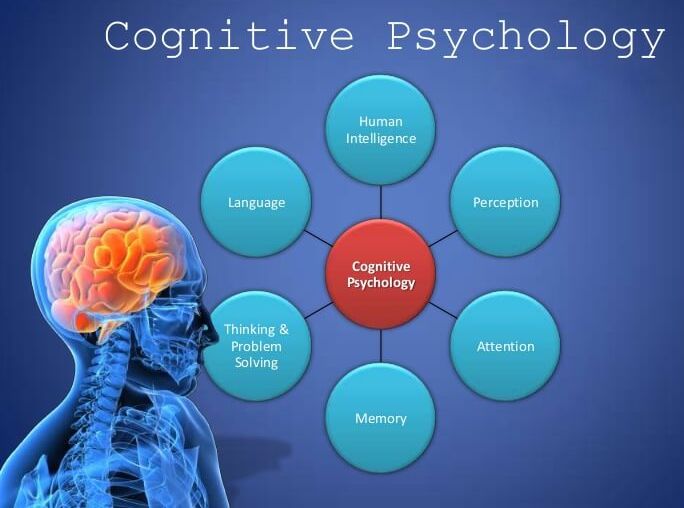
Cognitive psychology: School of psychology that focuses on how people perceive, store, and interpret information through such thought processes as memory, language, and problem solving.
Language: The use by humans of voice sounds and written symbols representing those sounds in organized combinations to express and to communicate thoughts and feelings.

Learning: Thorough knowledge or skill gained by study.

Memory: The power or ability of remembering past experiences.

Perception: The ability, act, or process of becoming aware of one's surrounding environment through the senses.

Reasoning: The drawing of conclusions and judgments through the use of reason.

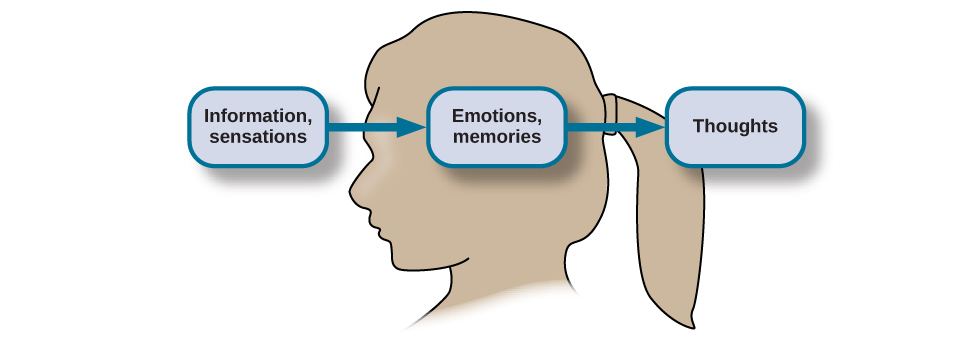
Perception: Perception or perceiving refers to the information we get from our five senses (sight, hearing, touch, smell, and taste). Studies have shown that our human senses perceive or take in far more information or data than our nervous systems can ever process or pay attention to. We get around this by organizing this data into chunks or groups, so that when we see a new object (such as a new type of car), we automatically compare it against the vast number of patterns or concepts we already have stored in our brains. When we find that it matches a concept—since we probably already have a general idea of what "carness" is, for example—we do not have to then process every little bit of detailed information about this new car to know that it is a car (that is, in order to perceive it or recognize and understand it as a car). At the end of this process, we have made a judgment of some sort about this new thing. Once scientists discovered this aspect of perception, they were better able to explain how people often see what they expect to see and are sometimes in fact mistaken. This happens when we take only that first, matching impression of something and conclude that it is correct (that is, that the reality is the same as the idea of it we have in our minds) without taking the time to check out all the details of a thing. However, this ability to conceptualize or to create concepts in our minds is very important and is one of the key functions or processes of cognition or knowing.

Reasoning and problem solving: Reasoning could be described as the process by which people systematically develop different arguments and, after consideration, arrive at a conclusion by choosing one. Like reasoning, problem solving also involves comparing things, but it is always aimed at coming to some sort of a solution. We usually do this by creating models of the problem in our minds and then comparing and judging the possible solutions. One thing we know about reasoning and problem solving is that it is usually much more difficult for people to do when it remains in the abstract. In other words, most people can more easily solve a problem if it is concrete than if it remains abstract. A common example given is the game "Rock breaks scissors, scissors cut paper, paper covers rock." When stated abstractly (A breaks B, B cuts C, and C covers A), we can easily become confused.

Learning: Swiss psychologist Jean Piaget (1896–1980) spent a lifetime studying how children learn, and he identified three stages that children go through as they grow and develop. In the first and simplest stage, an infant believes that an object is still where he or she first saw it, even though the infant had seen it moved to another place. In the second stage, the young child knows that it is at times separate from its environment and has developed concepts for things whether he or she is presently involved with them or not. The final, more mature stage has the older child understanding how to use symbols for things (such as things having names) and developing the ability to speak and use those symbols in language.

Memory: Memory, or the ability to recall something that was learned, is another cognitive function that is very important to learning. Scientists usually divide it into short-term and long-term memory. Our short-term memory seems to have a limited capacity, is very much involved with our everyday speech, and appears very important to our identity or our sense of self (who we are). Long-term memory stores information for much longer periods of time and seems to show no limitations at all. The three basic processes common to both types of memory—encoding or putting information into memory, storage, and retrieval—are exactly those used in today's computers.

Language: Although many animals besides human beings have a brain, nervous system, and some cognitive functions (that is, they share in a way many of the same processes of cognition), the one function of cognition that sets humans apart from other animals is the ability to communicate through language. Humans are unique in that they can express concepts as words. Some say that it is through studying language that we will gain an understanding of how the mind works. We do know that we form sentences with our words that allows us to express not just a single concept but complex ideas, rules, and propositions.

Understanding cognition or figuring out the process involved in knowing is something science has only really just begun. However, the combined work of philosophers, psychologists, and other scientists using new technologies for studying the brain may result in the next great scientific breakthrough—the explanation of how the human brain carries out its mental task of knowing.
Cognition

Cognition is the act of knowing or the process involved in knowing. When we "know" something, it means that we are not only aware or conscious of it, but that we can, in a way, make some sort of judgment about it. Cognition is therefore a very broad term that covers a complicated mental process involving such functions as perception, learning, memory, and problem solving.
The nature of cognition, or how we know, has been the subject of investigation since the time of the ancient Greeks. It has been studied by both philosophers and scientists. Around 1970, a new field of investigation called cognitive psychology began to emerge. Many of its practitioners study the brain and compare it to a computer in terms of its information storage and retrieval functions. However, most people who study cognition recognize that they are not focusing just on how the brain works as an organ, but are really more concerned with how the mind actually works. While there are still several competing theories all trying to explain how the mind works (or how we know), one idea common to most of them is that the mind builds concepts—which are like large symbolic groupings, patterns, or categories—that represent actual things in the real world. It then uses these concepts or patterns that it has already built when it meets a new object or event, and it can then compare the new object to the concept it has already stored.

Cognition includes several elements or processes that all work to describe how our knowledge is built up and our judgments are made. Among these many elements are the processes of perceiving, recognizing, conceptualizing, learning, reasoning, problem solving, memory, and language. Some of these processes may include others (for example, problem solving might be considered to be part of reasoning).

Pramāṇa

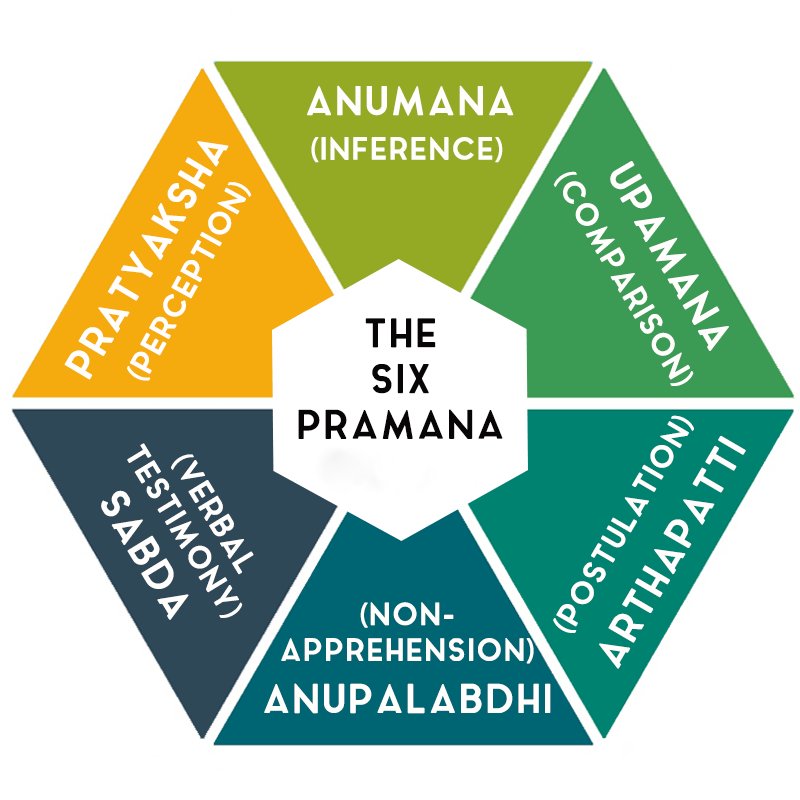
Pramāṇa (Sanskrit: प्रमाण, Pramāṇas) literally means "proof" and "means of knowledge". It refers to epistemology in Indian philosophies, and is one of the key, much debated fields of study in Hinduism, Buddhism and Jainism, since ancient times. It is a theory of knowledge, and encompasses one or more reliable and valid means by which human beings gain accurate, true knowledge. The focus of Pramana is how correct knowledge can be acquired, how one knows, how one doesn't, and to what extent knowledge pertinent about someone or something can be acquired.

Ancient and medieval Indian texts identify six pramanas as correct means of accurate knowledge and to truths: perception (Sanskrit pratyakṣa), inference (anumāna), comparison and analogy(upamāna), postulation, derivation from circumstances (arthāpatti), non-perception, negative/cognitive proof (anupalabdhi) and word, testimony of past or present reliable experts (Śabda). Each of these are further categorized in terms of conditionality, completeness, confidence and possibility of error, by each school of Indian philosophies.

The various schools of Indian philosophies vary on how many of these six are epistemically reliable and valid means to knowledge. For example, Carvaka school of Hinduism holds that only one (perception) is a reliable source of knowledge, Buddhism holds two (perception, inference) are valid means, Jainism holds three (perception, inference and testimony), while Mimamsa and Advaita Vedanta schools of Hinduism hold all six are useful and can be reliable means to knowledge. The various schools of Indian philosophy have debated whether one of the six forms of pramana can be derived from other, and the relative uniqueness of each. For example, Buddhism considers Buddha and other "valid persons", "valid scriptures" and "valid minds" as indisputable, but that such testimony is a form of perception and inference pramanas.

The science and study of Pramanas is called Nyaya.

Pramāṇa literally means "proof". The word also refers to a concept and field of Indian philosophy. The concept is derived from the Sanskrit root, prama (प्रमा) which means "correct notion, true knowledge, basis, foundation, accurate notion". Thus, the concept Pramana implies that which is a "means of acquiring prama or certain, correct, true knowledge".

Pramāṇa forms one part of a tripuţi (trio) of concepts, which describe the ancient Indian view on how knowledge is gained. The other two concepts are knower and knowable, each discussed in how they influence the knowledge, by their own characteristic and the process of knowing. The two are called Pramātŗ (प्रमातृ, the subject, the knower) and Prameya (प्रमेय, the object, the knowable).

The term Pramana is commonly found in various schools of Hinduism. In Buddhist literature, Pramana is referred to as Pramāṇavāda. Pramana is also related to the Indian concept of Yukti (युक्ति) which means active application of epistemology or what one already knows, innovation, clever expedients or connections, methodological or reasoning trick, joining together, application of contrivance, means, method, novelty or device to more efficiently achieve a purpose. 

Yukti and Pramana are discussed together in some Indian texts, with Yukti described as active process of gaining knowledge in contrast to passive process of gaining knowledge through observation/perception. The texts on Pramana, particularly by Samkhya, Yoga, Mimamsa and Advaita Vedanta schools of Hinduism, include in their meaning and scope "Theories of Errors", that is why human beings make error and reach incorrect knowledge, how can one know if one is wrong, and if so, how can one discover whether one's epistemic method was flawed, or one's conclusion (truth) was flawed, in order to revise oneself and reach correct knowledge.
x

Paper-I: Indian Philosophy(Epistemology and Meta Physics)

Syllabus: MA - Philosophy (Maharaja Ganga Singh University, Bikaner)

Note: There shall be three (03) Sections in the Question paper. Section A shall consist of ten questions (02 questions from each Unit), of 02 marks each, all compulsory to be answered in around 50 words. Section B shall consist of seven questions (at least 01 question from each Unit) of 08 marks each, to be answered in around 200 words. Five questions must be answered out of given seven. Section C shall consist of four questions (maximum 01 question from one Unit) of 20 marks each, to be answered in around 500 words. Two questions must be answered out of given four.

Duration: 3 Hrs. Max. Marks: 100

Unit-I

  • Cognition: Its definition and nature; valid (prama) and invalid (aprama); validity (pramanya); division of cognitions; classification of valid cognitions (prama); instruments (indriya) of valid cognition and their nature.
  • Validity of cognition: Its nature; condition and defintion. The debate about the nature, origin (utpatti) and ascertainment (jnapti) of validity, svatahpramanyavada, paratahpramanyavada, savisayatva, sakaratva, svaprakasatva, paraprakasata.

Unit-II

  • A study of pramanas: pratyaksa, anumana, sabda, upamana, arthapatti, anupalabdhi.
  • The theories about invalid perceptual cognitions (khyativada); akhyati anyathakhyati, viparitakhyati, atmakhyati, asatkhyati, anirvacaniyakhyati, satkhyati’ and sadasatkhyati.

Unit-III

  • God: the role of god in the world-views of classical systems: the new and central role of god in Bhakti schools starting with Ramanujacharya, Madhvacharya, N imbakacharya, Vallabhacharya, Ramananda.
  • Proofs for and against the existence of God: God as karmadhyaksa.

Unit-IV

  • Atman, nairatmyavada, nature and proofs for Atman. Atman and Jiva; the Jiva as karta, bhokta, and jnata; different perspectives.
  • Nature of Bandhan and Mokahsa, and means of mokasha according to various schools of Indian Philosophy.

Unit-V

  • Universals: the debate amongst the different schools.
  • Causation: a comparative study of causality in different schools.


Cognition: Its definition and nature

Cognition is "the mental action or process of acquiring knowledge and understanding through thought, experience, and the senses." It encompasses processes such as knowledge, attention, memory and working memory, judgment and evaluation, reasoning and "computation", problem solving and decision making, comprehension and production of language, etc. Human cognition is conscious and unconscious, concrete or abstract, as well as intuitive (like knowledge of a language) and conceptual (like a model of a language). Cognitive processes use existing knowledge and generate new knowledge.

The processes are analyzed from different perspectives within different contexts, notably in the fields of linguistics, anesthesia, neuroscience, psychiatry, psychology, education, philosophy, anthropology, biology, systemics, logic, and computer science.

These and other different approaches to the analysis of cognition are synthesised in the developing field of cognitive science, a progressively autonomous academic discipline. Within psychology and philosophy, the concept of cognition is closely related to abstract concepts such as mind and intelligence. It encompasses the mental functions, mental processes (thoughts), and states of intelligent entities (humans, collaborative groups, human organizations, highly autonomous machines, and artificial intelligences).

Thus, the term's usage varies across disciplines; for example, in psychology and cognitive science, "cognition" usually refers to an information processing view of an individual's psychological functions. It is also used in a branch of social psychology called social cognition to explain attitudes, attribution, and group dynamics. In cognitive psychology and cognitive engineering, cognition is typically assumed to be information processing in a participant’s or operator’s mind or brain. Cognition can in some specific and abstract sense also be artificial.

Cognition is a word that dates back to the 15th century, when it meant "thinking and awareness". Attention to the cognitive process came about more than eighteen centuries ago, beginning with Aristotle and his interest in the inner workings of the mind and how they affect the human experience. Aristotle focused on cognitive areas pertaining to memory, perception, and mental imagery. The Greek philosopher found great importance in ensuring that his studies were based on empirical evidence; scientific information that is gathered through observation and conscientious experimentation. Centuries later, as psychology became a burgeoning field of study in Europe and then gained a following in America, other scientists like Wilhelm Wundt, Herman Ebbinghaus, Mary Whiton Calkins, and William James, to name a few, would offer their contributions to the study of cognition.

Wilhelm Wundt (1832–1920) heavily emphasized the notion of what he called introspection: examining the inner feelings of an individual. With introspection, the subject had to be careful to describe his or her feelings in the most objective manner possible in order for Wundt to find the information scientific. Though Wundt's contributions are by no means minimal, modern psychologists find his methods to be quite subjective and choose to rely on more objective procedures of experimentation to make conclusions about the human cognitive process.

Hermann Ebbinghaus (1850–1909) conducted cognitive studies that mainly examined the function and capacity of human memory. Ebbinghaus developed his own experiment in which he constructed over 2,000 syllables made out of nonexistent words, for instance EAS. He then examined his own personal ability to learn these non-words. He purposely chose non-words as opposed to real words to control for the influence of pre-existing experience on what the words might symbolize, thus enabling easier recollection of them. Ebbinghaus observed and hypothesized a number of variables that may have affected his ability to learn and recall the non-words he created. One of the reasons, he concluded, was the amount of time between the presentation of the list of stimuli and the recitation or recall of same. Ebbinghaus was the first to record and plot a "learning curve," and a "forgetting curve." His work heavily influenced the study of serial position and its effect on memory, discussed in subsequent sections.

Mary Whiton Calkins (1863–1930) was an influential American pioneer in the realm of psychology. Her work also focused on the human memory capacity. A common theory, called the recency effect, can be attributed to the studies that she conducted. The recency effect, also discussed in the subsequent experiment section, is the tendency for individuals to be able to accurately recollect the final items presented in a sequence of stimuli. Her theory is closely related to the aforementioned study and conclusion of the memory experiments conducted by Hermann Ebbinghaus.

William James (1842–1910) is another pivotal figure in the history of cognitive science. James was quite discontent with Wundt's emphasis on introspection and Ebbinghaus' use of nonsense stimuli. He instead chose to focus on the human learning experience in everyday life and its importance to the study of cognition. James' major contribution was his textbook Principles of Psychology that preliminarily examines many aspects of cognition like perception, memory, reasoning, and attention, to name a few.

All Rights Reserved © Aditya Classes Bikaner